


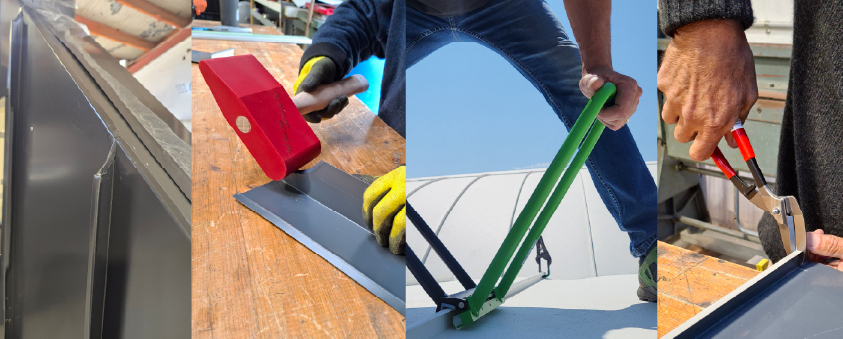
Why the Finish Matters More Than You Think
An Angled Standing Seam Cladding system is essential. Every tool, every technique, and every stage of installation either builds on the last or undermines it. The finish – the clean lines, the secure seams, the flawless surface – isn’t just about appearance. It’s the visible proof of a job done right. It’s what tells a client their investment was sound and what keeps your reputation solid for years to come.
But achieving that finish consistently comes down to more than skill. It requires the right tools for each specific stage of the work, tools that are designed to protect the material while helping you execute with precision. This month, we’re breaking down the key tools that make the difference between a roof that looks good on handover day and one that still looks good a decade later.
Start With the Right Grip - Choosing the Correct Clamp
An Angled Standing Seam Cladding system is only as consistent as the tool holding the panel while you work it. But not all clamps serve the same purpose, and using the wrong one at the wrong stage can create problems that will show up instantly.
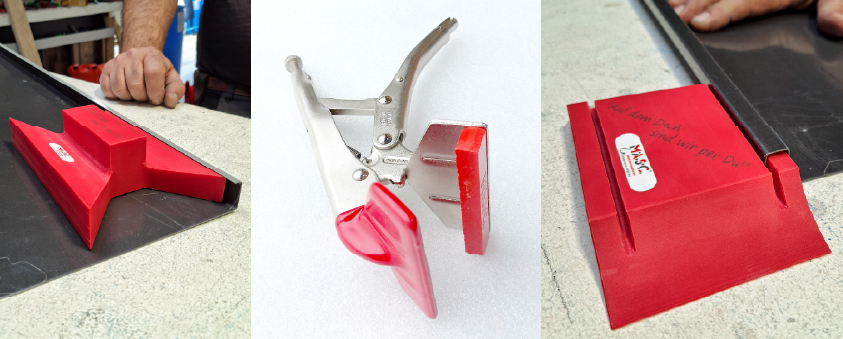
The standard MASC Standing Seam Clamps (SGZSK and SGZS) are designed for a specific job: moving sheets to the setout line. They clamp onto a clip or join two panels together to pull them into position. Because they close the gap between the male and female seams, they should not be left on during installation. Doing so, restricts the natural thermal movement the roof needs. That restriction can cause panels to buckle and form waves over time, creating critical damage.
The MASC Cladding Clamps (FGZ) are the correct tool to leave on during installation. These clamps are designed to securely hold standing seam walls and roofing panels together, ensuring the female and male seams are properly aligned while allowing for the natural expansion and contraction of the panels. Unlike the standard seam clamps, the FGZ clamps grip only the flat part of the panel, leaving the expansion gap open and unrestricted. They feature an adjustable quick-release handle for ease of use and easy-to-grip profiles for handling during installation.
To achieve a flawless standing seam finish, pair your Masc clamps with specialised finishing blocks like the Masc Seam Wedge and the 130mm Plastic Seaming Piece. Crafted from durable, non-marking plastic, the Seam Wedge delivers stable support for clean 45-degree and scalloped stop ends, while the 130mm Seaming Piece seamlessly forms and closes seams without damaging delicate painted or pre-coated metals.
Protect the Finish While You Shape It
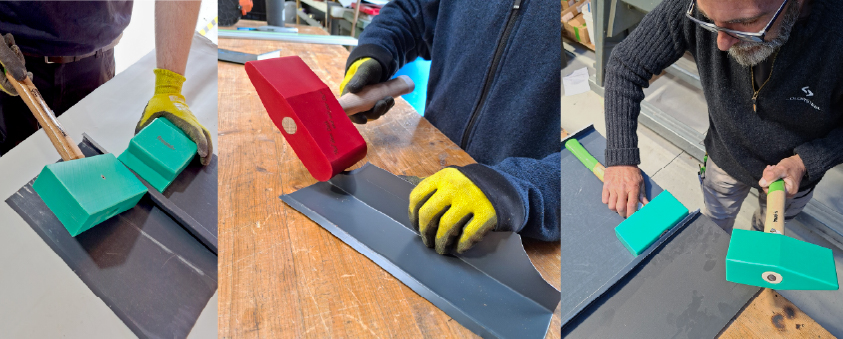
Every scratch in a pre-finished panel is a callback waiting to happen. The fix is simple, but it’s not always the tool you’d expect. Plastic hammers from Freund, Stubai and MASC are engineered to shape and dress sheet metal the same way a steel hammer does, but without marking or scarring painted or coated finishes.
One of many Plastic Hammer designs features a high-quality plastic head milled from a solid block, giving it rounded edges for gentle, mark-free contact on sheet metal. The MASC PE Wedge and Rounded Hammer offers a dual-face design with a V-shaped face and a rounded face made from durable red PE plastic, specifically for shaping and forming without damaging the material. On standing seam work, where the surface is the selling point, that difference shows the moment the roof catches the light.
The Step That Makes It Weathertight
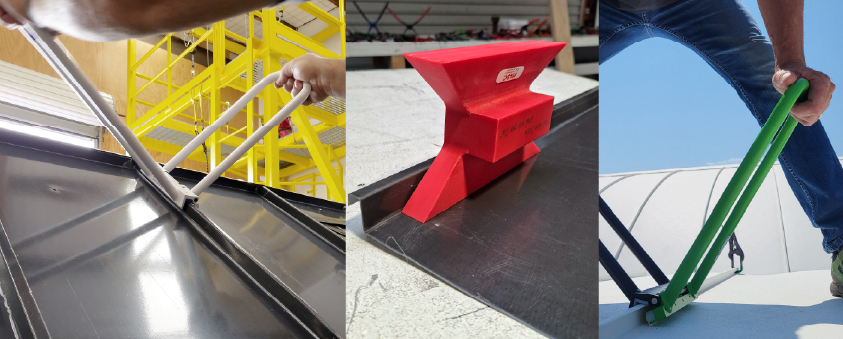
Closing the seam is where an Angled Standing Seam roof earns its name – and its reputation. Everything before this step is preparation; this is the step that actually keeps water out. To get it done right, the male and female edges need to be mechanically locked evenly along the full run.
The FBC Standing Seam Closer 2-in-1 is a dual-function tool designed for precise single and double standing seam closing action. With plastic inserts that protect coated surfaces and rubber inlays that improve grip and control. For those working with delicate finishes, the MASC Plastic Seaming Piece 130mm provides a scratch-free support surface when forming, closing, and adjusting seam stop ends. An inconsistent close will fail on day one, requiring a callback or
a redo. Consistent, efficient tools are what separate a roof that performs for decades from one that needs revisiting well before its time.
Getting the Details Right - Snips & Ventilation Flashings
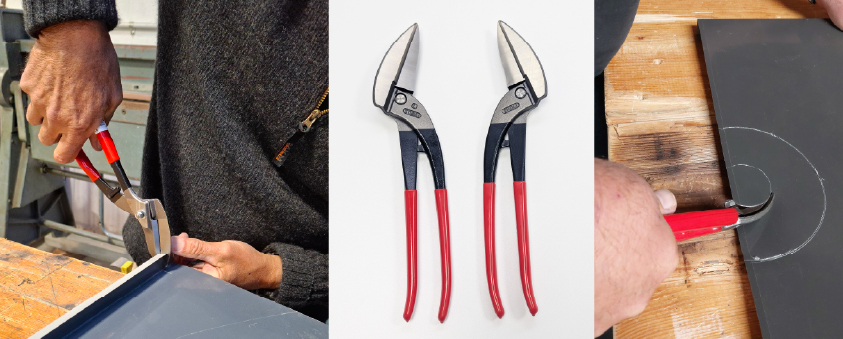
The last details on a standing seam roof are often the ones that go wrong first. Accurate cuts around penetrations and the flashings that keep the roof space dry. Curved and mini snips give the control to cut clean lines around curves and awkward angles, so detail work matches the quality of the main run. Stubai Curved Tin Snips are ideal for getting clean and controlled circular cuts, with induction-hardened blades made from durable C60 carbon steel. The Stubai
Micro Combination Tin Snips offer the best performance for small spaces, tight corners, or that
tricky corner.
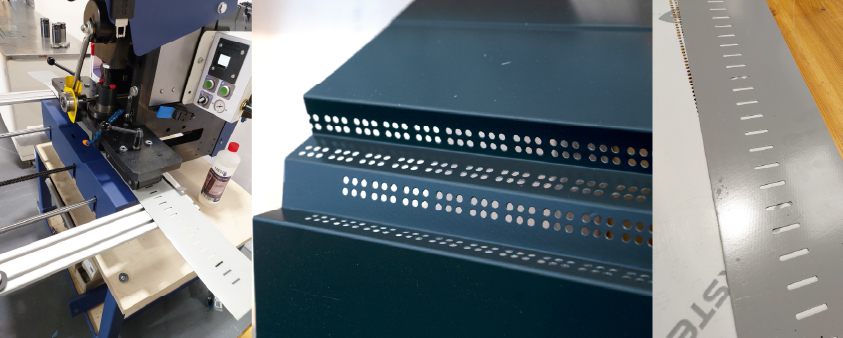
Perforated flashings do the less visible job – letting air move through the roof space to reduce the condensation that quietly grows mould, rotting the framing from the inside. While still shedding wind-driven rain on the outside. Small components, real consequences: clean cuts and proper ventilation are what keep a good roof good for the long run.
Built to Perform, Built to Last
The tools that define a professional’s work are the ones that respect the material and the craft. From the first clamp that holds a panel true, to the final snip that cleans up a detail, every tool in this series is chosen for a reason: to help you do the job right the first time, and to keep doing it for years.
At Fribesco, we supply the tools that make that standard achievable. Because a standing seam roof is only as good as the hands – and the tools – that build it.
Comments (0)